
Sarcoma Awareness: Shedding Light on Sarcoma
 Sarcoma Awareness – What You Need to Know
Every year, the month of July is dedicated to raising awareness about sarcoma, a rare and often misunderstood group of cancers. These cancers are often challenging to diagnose, as their symptoms can mimic other conditions or be mistaken for sports injuries.
It is estimated that 13,520 new soft tissue sarcomas will be diagnosed in the coming year, resulting in about 5,420 deaths ¹. Raising awareness about sarcoma highlights the importance of recognizing its signs and symptoms.
By educating individuals about these indicators, we empower them to seek medical attention promptly, enabling early detection and intervention. This timely detection can impact treatment outcomes and potentially save lives.
 Understanding Sarcoma
Sarcoma is a diverse group of rare cancers that develop in the bones, muscles, tendons, cartilage, nerves, and other connective tissues in the body. There are two major types of sarcomas: soft tissue sarcoma and osteosarcoma.
Each type has distinct characteristics and may require specific treatment approaches. Soft tissue sarcomas most often occur in the limbs (arms and legs) or the intra-abdominal organs (like the stomach or liver) ².
Certain types of soft tissue sarcomas occur more often in certain parts of the body. For example, leiomyosarcomas are the most common type of sarcoma found in the abdomen, while liposarcomas and undifferentiated pleomorphic sarcomas are most common in legs ¹.
Osteosarcoma, one of the most common types of cancer that starts in the bones, most commonly occurs in children, teens, and young adults ³. This type of sarcoma often forms where bone is growing quickly, such as near the ends of leg or arm bones ³. Osteosarcoma is less common than soft tissue sarcoma.
Signs and Symptoms
Sarcoma symptoms can vary depending on the location and size of the tumor. Common signs include:
- A noticeable lump or swelling that may or may not be painful
- Unexplained pain or tenderness near the affected area
- Limited mobility or difficulty moving a limb
- Fatigue
- Unintentional weight loss
It is crucial to seek medical attention if any of these symptoms persist or worsen, especially if accompanied by other concerning factors. Early detection plays a vital role in improving treatment outcomes and increasing survival rates for sarcoma patients.
Diagnosis and Treatment
 Diagnosing sarcoma typically involves a combination of imaging tests (such as X-rays, CT scans, and MRIs), and biopsies. Once diagnosed, treatment options depend on the type, stage, and location of the sarcoma.
The primary treatments may include surgery, radiation therapy, and chemotherapy. Treatment plans are often tailored to individual patients, considering their overall health and specific needs.
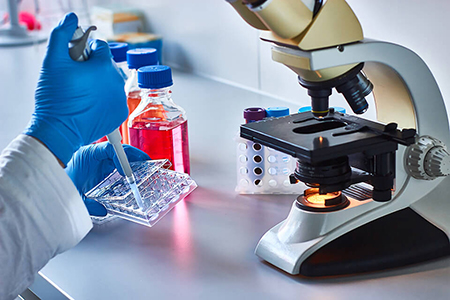
HNL Lab Medicine pathologists look at biopsies under the microscope and utilize a variety of tests that might include immunohistochemistry, cytogenetic analysis, fluorescence in-situ hybridization, or molecular profiling to provide both an accurate diagnosis and data necessary to create a personalized treatment plan.
Workplace Safety
 Occupational exposure to certain substances and environmental factors has been linked to an increased risk of developing sarcoma, emphasizing the importance of workplace safety and protective measures.
Sarcoma is a relatively rare form of cancer, but occupational exposure can heighten the risk for certain individuals. In industries such as manufacturing, construction, woodworking, agriculture, and chemical production, workers may encounter substances that have been associated with sarcoma development.
These substances include dioxins, phenoxy herbicides, vinyl chloride, and arsenic 4,5. Prolonged and repeated exposure to these substances can potentially lead to the development of sarcomas.
Other Risk Factors
Just as in diagnosis and treatment, genetic testing can help inform patients of risk factors. Having certain inherited disorders can increase the risk of developing sarcoma. These inherited disorders include 6,7:
- Li-Fraumeni syndrome (TP53 variant)
- von Recklinghausen disease (neurofibromatosis type 1; NF1 variant)
- Gardner syndrome (APC variant)
- Nevoid basal cell carcinoma syndrome (Gorlin syndrome; PTCH1 variant)
- Tuberous sclerosis (Bourneville disease; TSC1 or TSC2 variant)
- Werner syndrome (adult progeria; WRN variant)
- Rothmund-Thomson syndrome (REQL4 variant)
 Raising Awareness
Sarcoma is a rare form of cancer that deserves more attention and support. Discuss sarcoma with your loved ones, especially if they work in an industry that might increase their risk.
By educating them about the signs and symptoms associated with sarcoma, we enable them to recognize potential warning signs and seek medical attention promptly.
Early detection plays a vital role in improving treatment outcomes and increasing survival rates for sarcoma patients.
For more information about sarcoma, visit the National Cancer Institute.
REFERENCES
¹ American Cancer Society. (2025, January 16). Key statistics for soft tissue sarcomas. https://www.cancer.org/cancer/types/soft-tissue-sarcoma/about/key-statistics.html .
² National Cancer Institute. (2025, February 21). Soft tissue sarcoma treatment (PDQ)- Health professional version. U.S. Department of Health and Human Services. https://www.cancer.gov/types/soft-tissue-sarcoma/hp/adult-soft-tissue-treatment-pdq#_1.
³ American Cancer Society. (2020, October 08). What is osteosarcoma? https://www.cancer.org/cancer/types/osteosarcoma/about/what-is-osteosarcoma.html.
⁴ Kogevinas, M., Becher, H., Benn, T., Bertazzi, P. A., Boffetta, P., Bueno-de-Mesqurta, H. B., Coggon, D., Colin, D., Flesch-Janys, D., Fingerhut, M., Green, L., Kauppinen, T., Littorin, M., Lynge, E., Mathews, J. D., Neuberger, M., Pearce, N., & Saracci, R. (1997). Cancer mortality in workers exposed to phenoxy herbicides, chlorophenols, and dioxins an expanded and updated International Cohort Study. American Journal of Epidemiology, 145(12), 1061–1075. https://doi.org/10.1093/oxfordjournals.aje.a009069.
⁵ Edwards, D., Voronina, A., Attwood, K., & Grand'Maison, A. (2021). Association between occupational exposures and sarcoma incidence and mortality: systematic review and meta-analysis. Systematic reviews, 10(1), 231. https://doi.org/10.1186/s13643-021-01769-4.
⁶ American Cancer Society. (2018, April 06). Risk Factors for Soft Tissue Sarcomas. https://www.cancer.org/cancer/types/soft-tissue-sarcoma/causes-risks-prevention/risk-factors.html.
⁷ American Cancer Society. (2020, October 08). Osteosarcoma Risk Factors. https://www.cancer.org/cancer/types/osteosarcoma/causes-risks-prevention/risk-factors.html
Updated:6/9/25